
Abbey Luck’s debut graphic novel Pig Wife throws us into a deeply unsettling survival story centered on a teenager named Mary, who ends up lost in the winding tunnels of an abandoned mine. This underground world is dark, filthy, and anything but peaceful—and if Mary ever wants to see daylight again, she’ll have to push through some truly disturbing family secrets along the way.
The book kicks off with an excruciatingly awkward family road trip. Mary, her mom, and her stepdad are headed to the isolated country house of a recently deceased relative named Pearl, who’s rumored to have left behind a fortune. Pearl was Mary’s stepdad’s aunt, and he’s about as unpleasant as you’d expect—mean to Mary’s mom and completely intolerant of Mary’s teenage attitude.
By the time they reach Pearl’s place, everyone’s nerves are shot. The house turns out to be a hoarder’s nightmare, falling apart and packed with junk. While Mary’s stepdad digs through the mess looking for a will, Mary sneaks a bottle of whiskey out of his briefcase. This… does not go over well. To avoid his wrath, she bolts for Pearl’s pig shed, where she finds a trapdoor in the floor. Figuring she can hide out for a bit, she climbs down—only to discover the door won’t open from the inside. With no way back up, Mary has no choice but to go deeper.
That’s where Pig Wife really gets going. Most of the book takes place in the mine tunnels once owned by Pearl’s family. Down there, Mary meets Pearl’s son Ed and his “brother” Tommy, two boys who’ve been raised underground and taught that the surface world was destroyed in some kind of apocalypse. They worship Pearl, believing she bravely fought demons to bring them food. So when Mary shows up, they assume Pearl has sent them the ultimate prize: a wife.
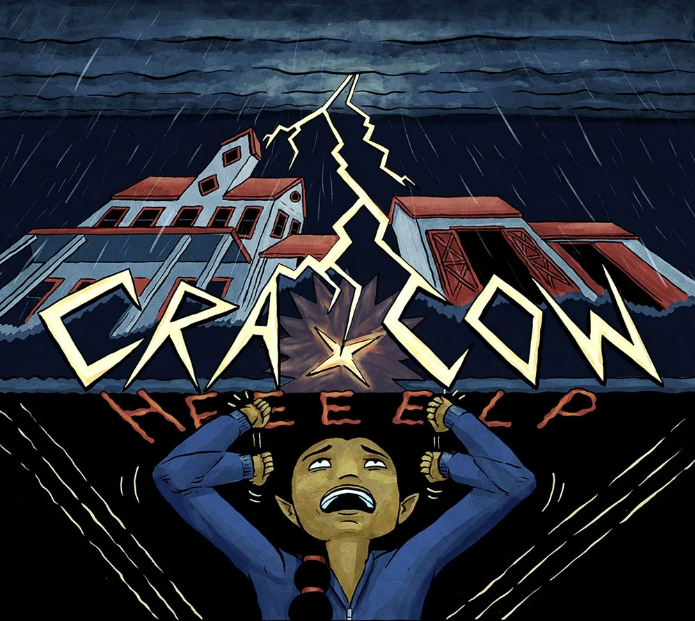
Understandably, Mary is horrified. Ed is volatile and violent, and Tommy is terrified of him. But as bad as the situation is, Mary’s past has sadly prepared her for it. She grew up with a biological father who was an alcoholic musician, dependent on Mary’s mom for support. She knows better than to wait around for someone to save her. If she’s getting out of the mine, she’ll have to figure it out herself—while navigating Ed and Tommy’s warped, well-meaning, but deeply creepy behavior.
Now, this might sound like a criticism at first, but stick with me: Pig Wife leans heavily on familiar character types. You’ve got the rebellious teen who smokes and fights, the deadbeat dad, the self-sacrificing mom, the selfish and delusional maternal figure, the violent man, the passive one. The city is grimy and dangerous; the countryside is full of deeply unsettling weirdos.
But here’s the thing—that’s actually part of why the book works so well. Because we already recognize these archetypes, the story moves incredibly fast. And that matters, because this is a huge graphic novel—over 500 pages. Despite that, it’s completely possible to tear through it in one tense, breathless sitting. By skipping subtle character nuance, Pig Wife goes all-in on momentum, and once it grabs you, it drags you straight down into the tunnels alongside Mary.
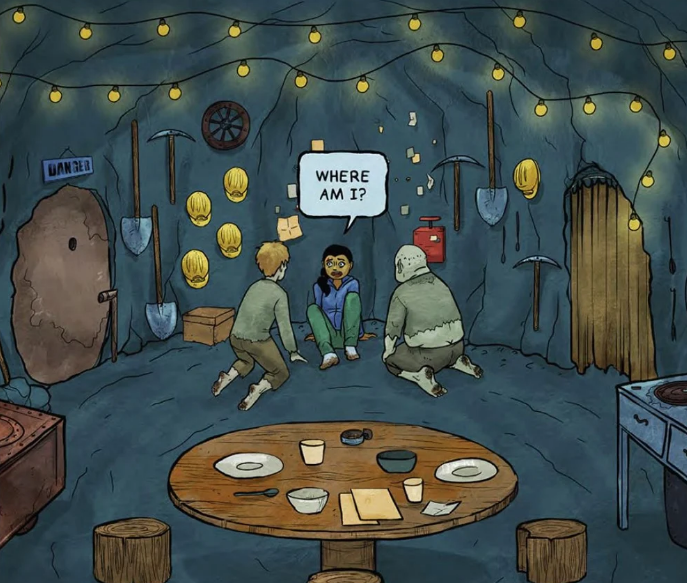
Those broad strokes also make the book’s deeper themes hit harder. At its core, this is a coming-of-age story—but it taps into a version of growing up that feels especially familiar for teenage girls (and for trans girls, too). It’s not just about leaving childhood behind; it’s about clawing your way out of what feels like a pit of internalized sexism, fear, and expectation.
The mine is a perfect visual metaphor for that pit. Ed represents violent masculinity, Tommy represents passive masculinity, and Pearl embodies a warped version of adult femininity—controlling, delusional, and self-mythologizing. Meanwhile, the mysterious “pig wife” locked away in the tunnels represents another suffocating stereotype: womanhood reduced to something mindless and sexual. For Mary to grow up and move forward, she has to leave all of these roles behind and carve out her own path back to the surface.
And for what it’s worth: no actual pigs are harmed. A lot of coming-of-age stories rely on killing an animal for symbolic weight, but Pig Wife rejects that idea. If the pigs don’t make it out okay, the book suggests, then none of us really do.
Visually, Pig Wife is just as striking as its story. Abbey Luck and Ruka Bravo’s art is highly stylized but easy to follow, leaning into the weirdness of the underground world. The early pages feel rough and gritty, like photocopied punk zines, before settling into a warmer, more inviting style that somehow makes the tunnels feel both charming and deeply wrong. That contrast works beautifully, especially as the characters grow more unsettling the longer we’re with them.
There’s a lot to unpack in Pig Wife, and it rewards careful reading and discussion. But it also works incredibly well as pure, gut-level entertainment—a nightmarish, haunted-house ride that never lets up. No matter who you are, there’s probably a weird teenage girl buried somewhere in your heart, and spending time with her dark fantasies before letting her go can feel strangely liberating.